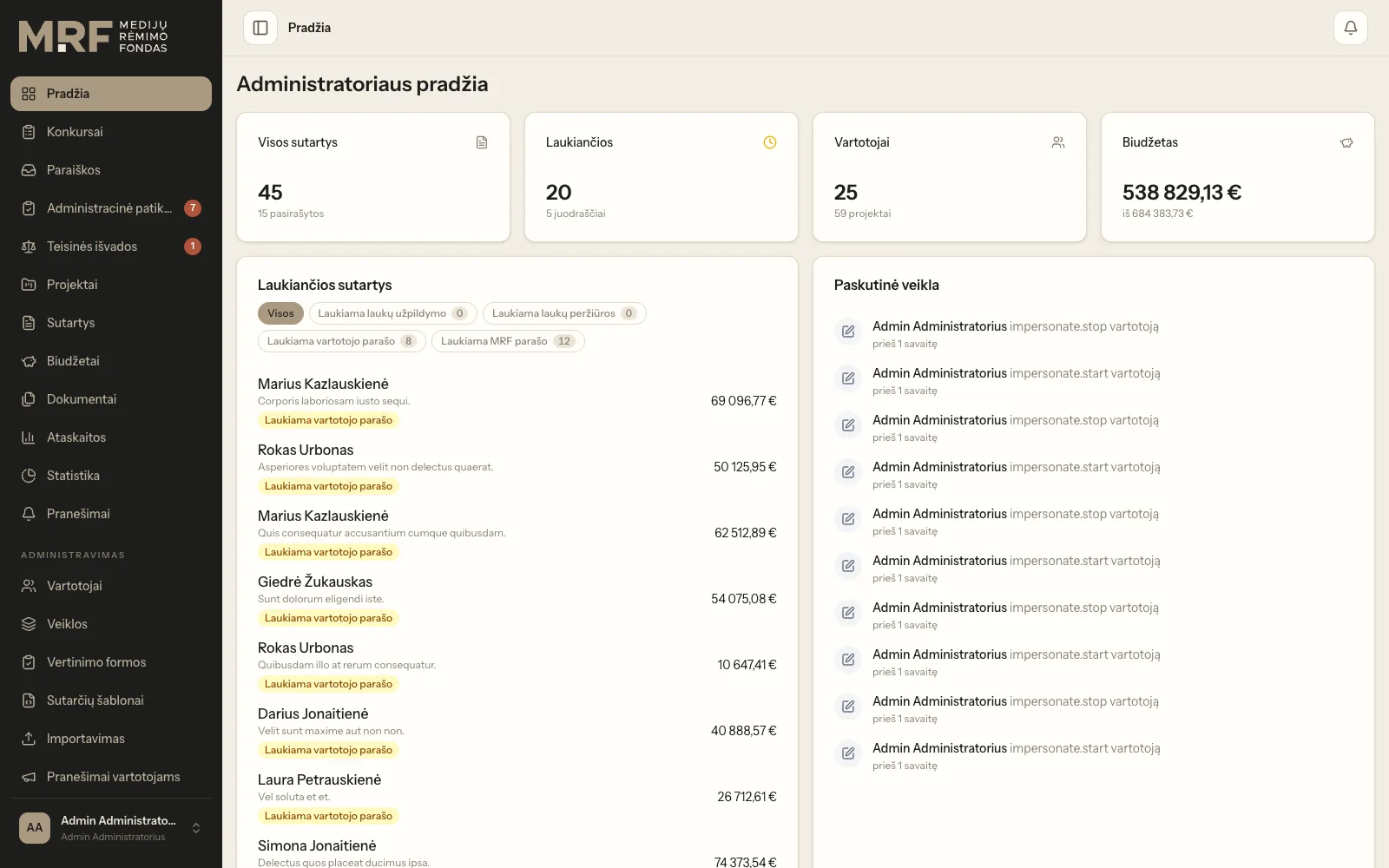
Grant application assessment and contract e-signing platform
Application intake, expert assessment, budget approval and electronic contract signing in a single workflow.
Systems for institutions whose requirements come not only from users but also from legislation. Accessibility, data protection and procurement documents are planned from the start.
Software development for the public sector differs from a commercial project not in technology but in procedure. The system must not only work, it must also comply with legislation, be purchased under public procurement rules and remain transferable when the maintainer changes. These three factors shape the result more than any technology choice.
We do not work on showcase websites but on systems where the actual work happens: applications are received, documents are assessed, registers are maintained and residents are served.
Technically these are the same web applications, only with an additional layer of requirements that private buyers do not have.
Accessibility and data protection are cheapest to build in at the design stage. Adding them to a finished system costs several times more, and sometimes means rebuilding the interface.
Description of General Requirements. Websites of Lithuanian state and municipal institutions are governed by a description approved by Government Resolution No. 480. It sets out not only accessibility but also a mandatory structure: which sections must exist, what information is published and how it is kept up to date.
WCAG 2.1 AA. The accessibility requirements stem from Directive (EU) 2016/2102 of the European Parliament and of the Council (the Web Accessibility Directive) and apply as a mandatory minimum. In practice this means contrast, keyboard operation, text alternatives, associated form labels and accessible documents. We do not rely on automated tools alone, because they cannot detect some of the requirements.
Accessibility statement. An institution must publish how far its website meets the requirements and where it falls short. We prepare the technical part of this document from the audit results, not from guesswork.
Personal data. Role-based access rights, an action log, retention periods and deletion of data once the period expires. The data location is set out in the contract rather than left to the supplier's discretion.
The most common obstacle in institutions is not the decision to buy but the document to buy against. Without it, suppliers price different scopes and proposals cannot be compared.
The technical specification is written in terms of functional requirements and a description of the outcome, without references to specific products, brand names or patents that would favour a single supplier. It is a separate service, and it may end with someone else building the system: IT consulting and system design.
In the public sector the maintainer changes every few years through a new procurement. A system that another supplier cannot take over becomes the institution's problem, not the developer's.
That is why the code, database, documentation and access credentials are handed over to the institution, and the system is built on an open source foundation without proprietary components that nobody else could license. The same principle applies to integrations: connections are documented so that someone else can maintain them.
We start with an analysis that ends with a scope and an estimate. Then come a prototype, development in stages, testing and launch with training. Each stage ends with a tangible result that can be submitted as evidence of progress if the project is funded by the EU. More about our process.
Similar projects, where the whole workflow from application to contract runs in a single system, are described in the case studies of the contract management and e-signing platform and the association membership and events system.
Both routes are legitimate. The difference is where responsibility ends up.
| Criterion | Off-the-shelf product | Custom system |
|---|---|---|
| Fit with procedure | Procedure adapts to the product | System adapts to the procedure |
| Accessibility responsibility | Depends on the vendor's roadmap | Written into the contract as a condition |
| Implementation time | Weeks | Months, depending on scope |
| Data location | Vendor's infrastructure | Server chosen by the institution |
| Integration with registers | Only those the vendor provides | Any system with an API |
| Changing maintainer | Depends on the vendor | Code and data are handed over |
| Long-term cost | Grows with the number of users | Maintenance not tied to user numbers |
Yes. The specification is written in terms of functional requirements and a description of the outcome, without references to specific products or brand names that would favour a single supplier. It is a separate service, and it may well end with someone else building the system.
Text must have a contrast ratio of at least 4.5:1 against its background, the whole website must be operable by keyboard, every image needs a text alternative, form fields need associated labels and videos need captions. Then there is what is often forgotten: PDF documents published on the website must be accessible too.
It is a public document in which the institution states how far its website meets the requirements, which parts do not and why, and how to report a problem. The institution publishes the statement itself, but we prepare its technical part based on the results of the accessibility audit.
Yes, and this is written into the contract as an acceptance condition, not as a promise. The Description of General Requirements approved by the resolution covers not only accessibility but also a mandatory structure: which sections must exist, what information is published and how it is kept up to date.
Wherever the institution specifies. Most often that means servers in Lithuania or elsewhere in the European Union. The system is built so that it is not tied to a single cloud provider, so the location can be changed later.
We hand over the code, the database, the documentation and all access credentials. The system can be moved to another maintainer without technical obstacles because it does not rely on proprietary components of ours. This matters in the public sector in particular, where the maintainer changes every few years through a new procurement.
Yes, as long as there is access to the code and the data. We start with a review that assesses its condition, security gaps and how far the system meets current requirements. After that it is clear whether it is cheaper to fix the existing system or build a new one.
Yes, if they have an API or another method of data exchange. Integrations are described as early as the analysis stage, because they usually determine both the timeline and the cost.
The work is split into stages with clear deliverables that can be submitted as evidence of progress. Each stage ends with something tangible: a document, a working version or a test report, so reporting requirements do not catch the project out at the end.
Application intake, expert assessment, budget approval and electronic contract signing in a single workflow.
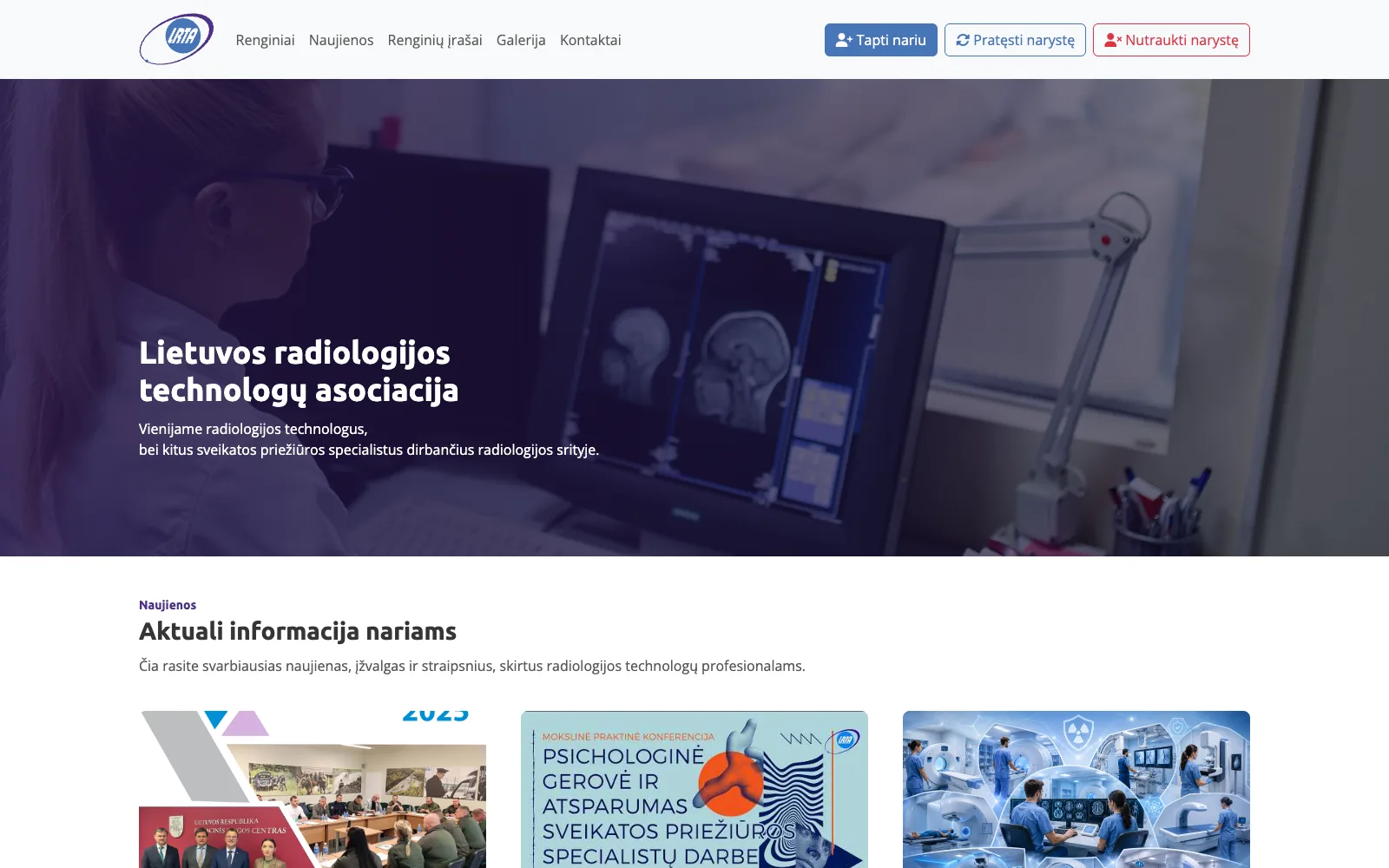
Membership years, applications, event registrations and board information in one system.
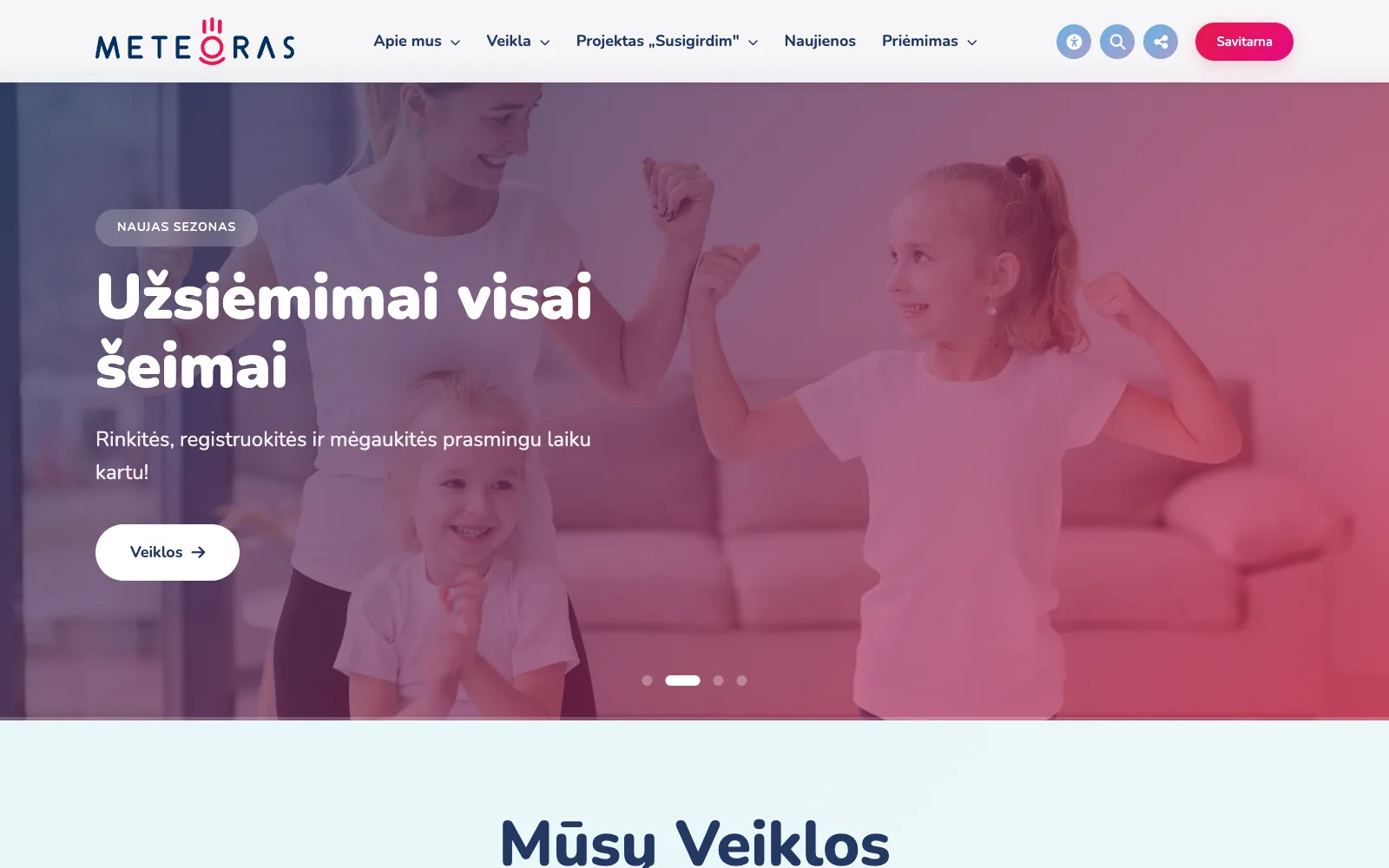
An activity catalogue with free places, registration, contract signing with a qualified e-signature and an attendance register.
Tell us which procedure the system needs to support. We will get back to you with questions and an initial direction within one working day.
Or directly: info@desamedia.lt · +370 686 59999