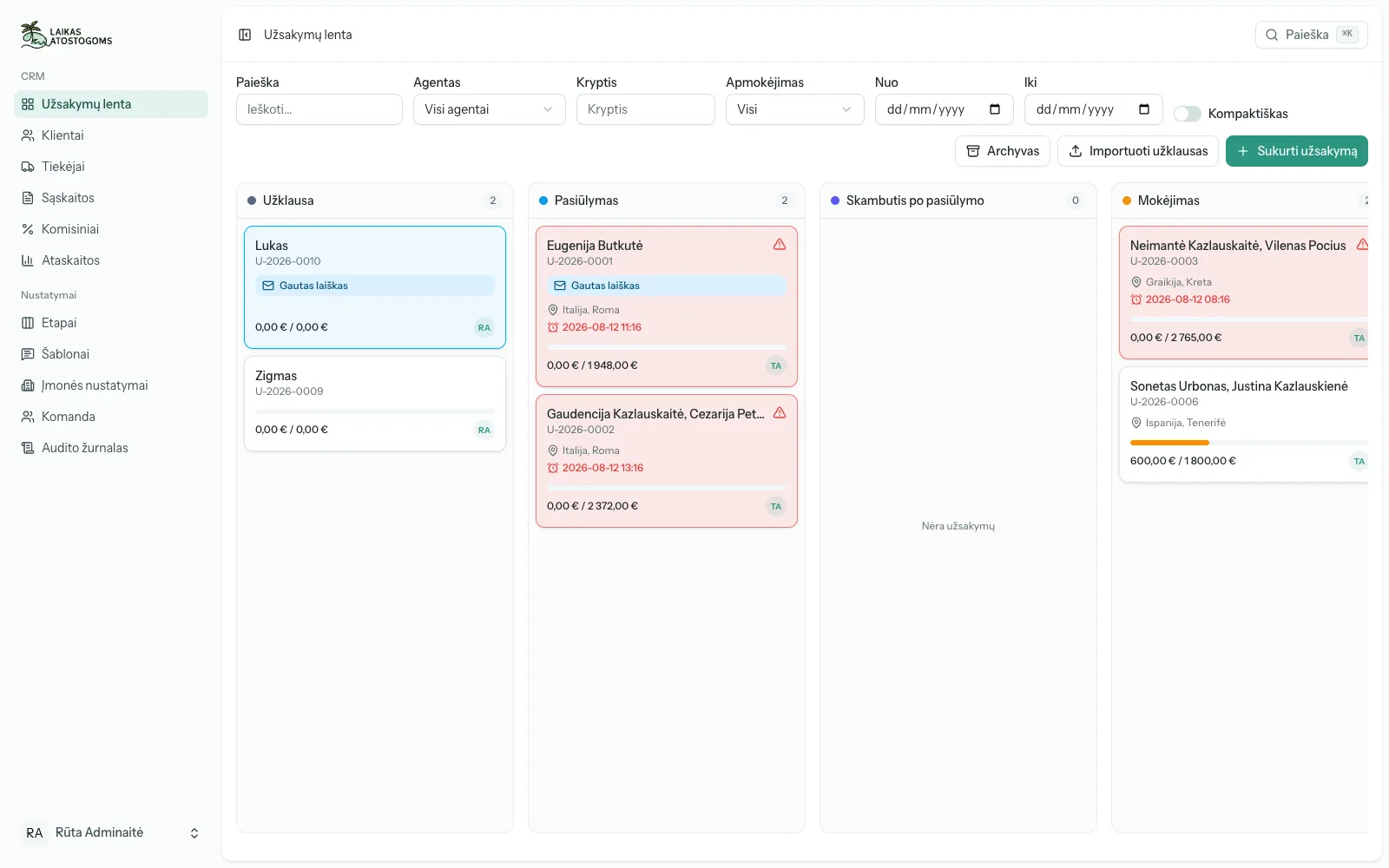
Travel agency CRM: bookings, payments and invoices in one place
A booking board, client email, Paysera payments, invoices and AT01 reports in a single system for a travel agency.
A system for clients, sales and processes, shaped around how you actually work, with integrations into accounting and email.
A CRM system is a tool that holds the full history of each client: enquiry, conversations, quotes, contracts and payments. A custom CRM differs from an off-the-shelf one in that its stages, fields and rules mirror the company's real sales process rather than a generic template.
In ready-made systems the process usually looks like this: contact, deal, stage, closed. In reality, between the enquiry and the payment there are supplier bookings, approvals from several people, deposits and documents. A custom CRM names those steps directly, so a sales manager does not have to keep half the process in their head or in a separate spreadsheet.
A CRM is only worth as much as its connections to the rest of the company. The most common links are accounting software, email, calendar, online store and document signing services. More on this in integrations and automation.
Once production, warehousing or resource planning enter the system, it is no longer CRM territory. In that case, see business management systems.
| Criterion | Off-the-shelf CRM | Custom CRM |
|---|---|---|
| Time to launch | A few days | Weeks or months |
| Cost | Monthly fee for every user | One-off investment plus maintenance |
| Process fit | Standard pipeline | Your stages and rules |
| Fields and logic | Limited customisation | No limitations |
| Integrations | From the vendor catalogue | Any system with an API |
| Data control | In the vendor cloud | On a server of your choice |
| Number of users | Every new user costs more | No effect on price |
An off-the-shelf CRM offers a standard sales pipeline and expects you to adapt to it. A custom CRM is built around your actual process: if you have five stages between enquiry and contract, each with a different owner, the system will look exactly like that rather than a generic kanban board.
When sales managers duplicate data in spreadsheets because the CRM does not cover part of the process; when licence costs outweigh the benefit; when you need an integration the platform does not allow; or when sales are inseparable from production or logistics, which ready-made CRM products do not cover.
Yes. Migration is a separate stage of the work: we extract the data, clean up duplicates, map the fields and transfer everything with verification. The old system usually runs in parallel for a while.
Any system with an API or a file exchange interface, for example Lithuanian accounting systems such as B1, Rivilė, Directo or Agnum. The integration principle is similar for all of them, so connecting a new system is not a challenge in itself. If there is no API, we use an intermediate data exchange layer.
Yes. The interface is responsive, so it works in the browser on any device. If a specific field work scenario is needed, we build a separate simplified view for it.
There is no technical limit and no per-user fee. The number of users only affects server capacity, not licence costs.
A booking board, client email, Paysera payments, invoices and AT01 reports in a single system for a travel agency.
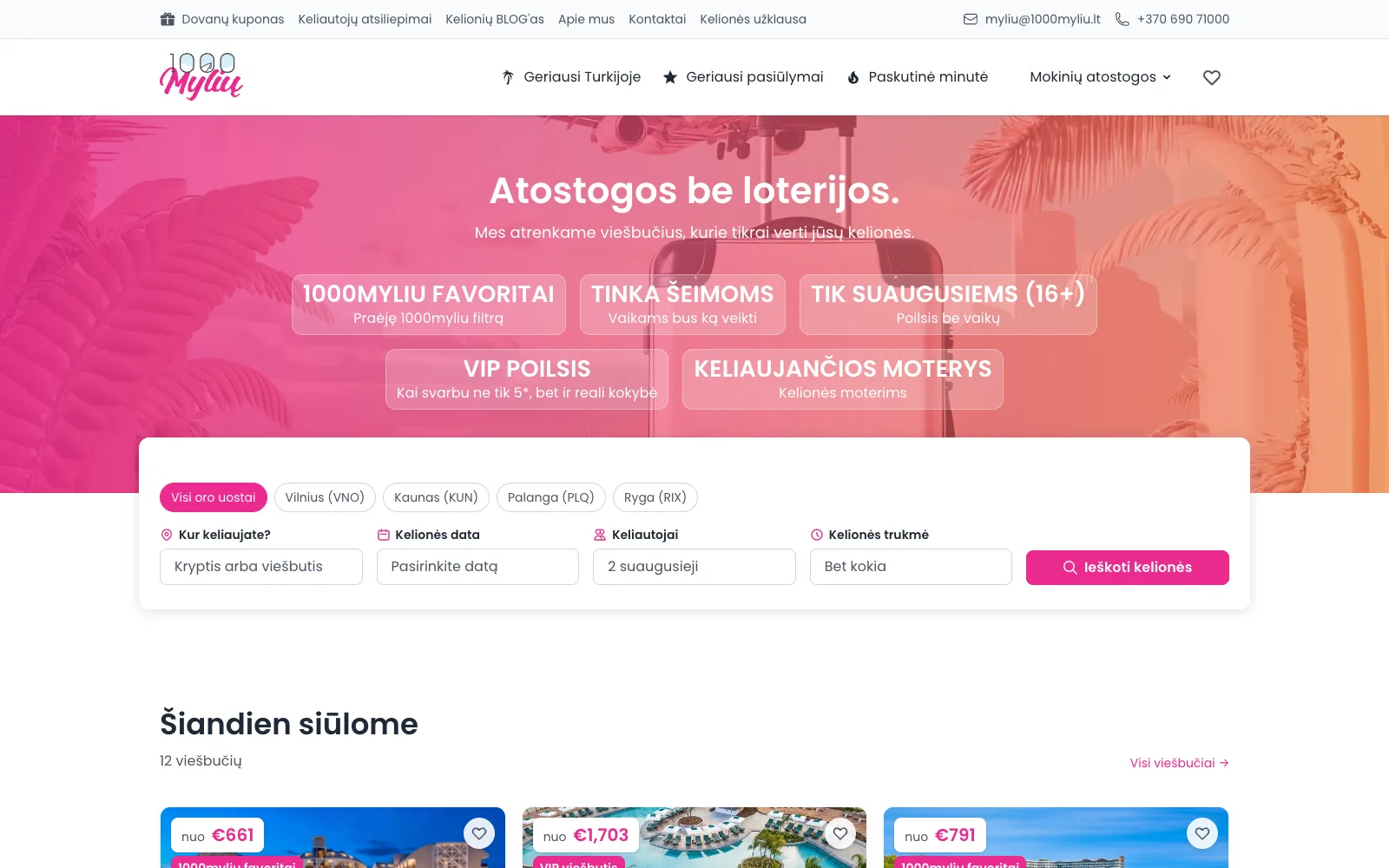
Almost 400 holidays with continuously updated prices, the agency's own hotel reviews, enquiries and bookings in one system.
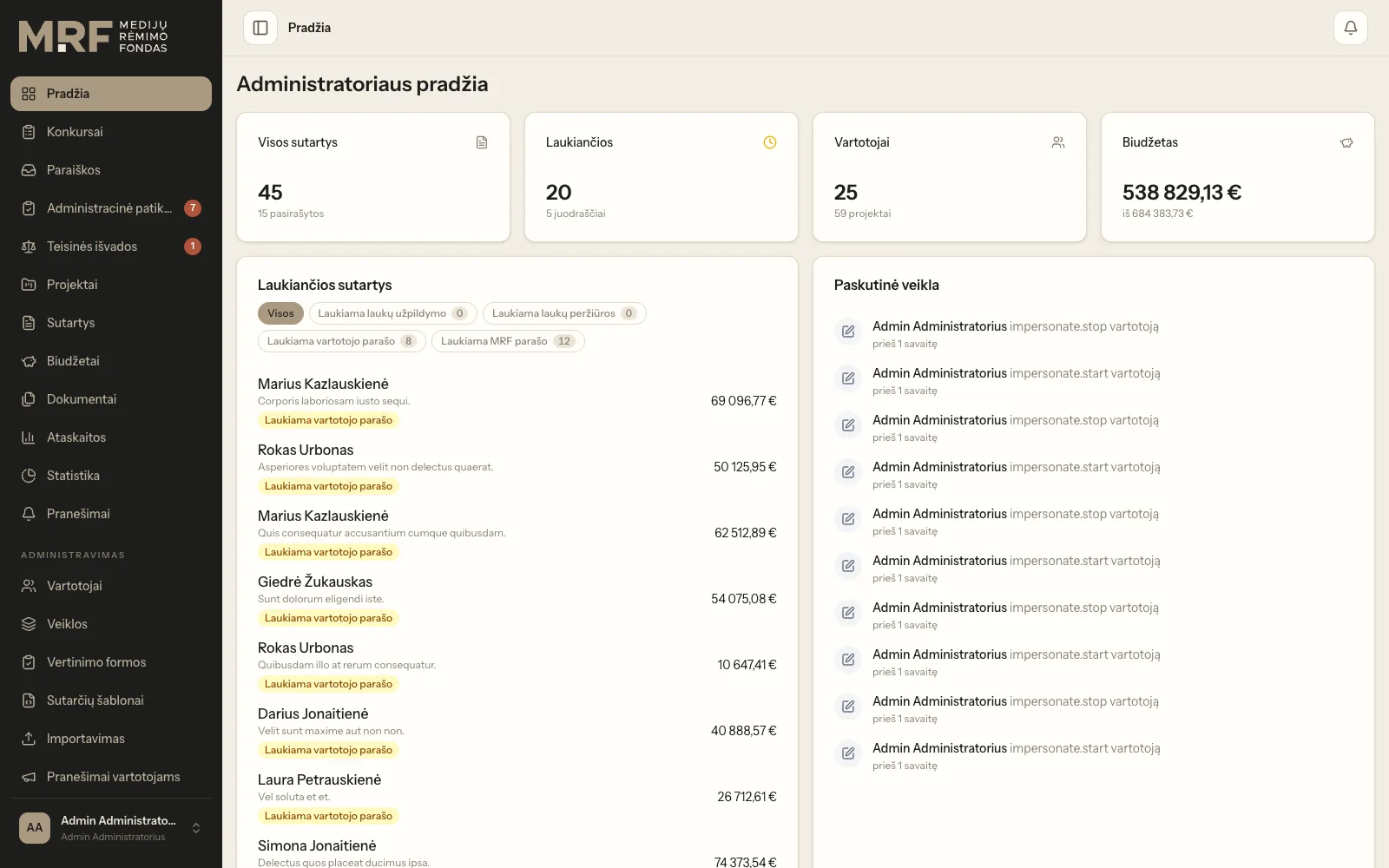
Application intake, expert assessment, budget approval and electronic contract signing in a single workflow.
We will get back to you with questions and an initial direction within one business day.
Or directly: info@desamedia.lt · +370 686 59999