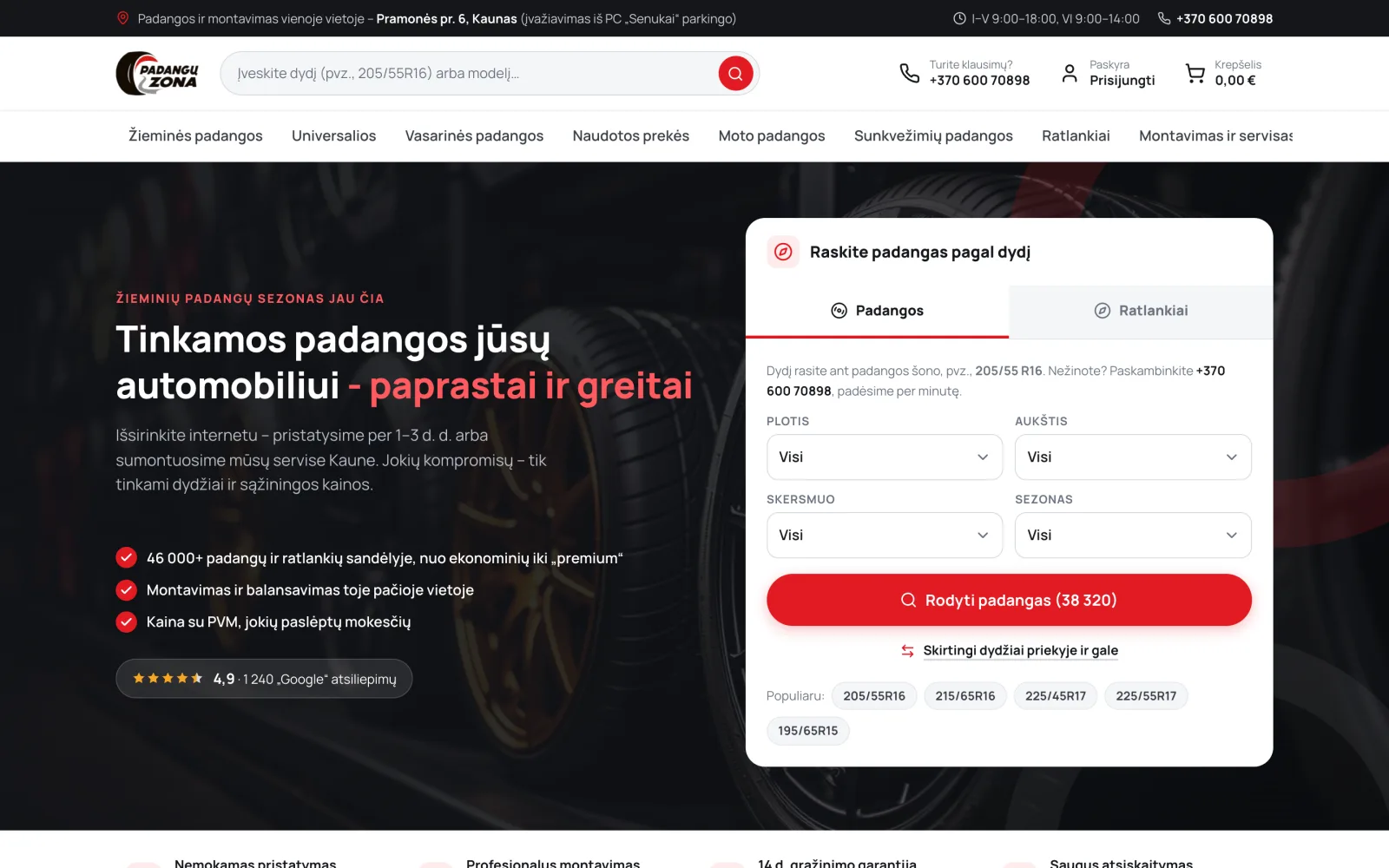
Tyre online store with fitting service booking
Parametric tyre and wheel search, basket, coupons and fitting appointment booking.
A tyre and wheel store with supplier stock imports, parametric search and product comparison.
ProblemAlmost 30,000 products come from several suppliers who describe the same item differently, while buyers choose by size and vehicle, not by product name.
SolutionWe built a store that automatically imports supplier catalogues and stock levels with an import log, extracts technical parameters for search and lets buyers compare up to four products.
The tyre and wheel store sells online across Lithuania. Most of its products are not held in its own warehouse: they are supplied by several wholesalers, each with its own catalogue, prices and stock levels. The store currently lists almost 30,000 products, of which around 22,000 are tyres and almost 8,000 are wheels.
Buyers here do not search by product name. They know the numbers from the sidewall of their old tyre or the make of their car, and want to see only products that fit.
Data took the most effort. Suppliers describe the same product differently: one writes "205/55R16 Michelin", another starts with the manufacturer, a third lists wheels in English. For search to work, width, profile, diameter, season, bolt pattern and other parameters had to be extracted from these descriptions.
Accuracy matters too. If you sell a tyre the supplier no longer has, you have to call the buyer and cancel the order. So stock levels and prices have to update automatically, with no manual work.
Supplier imports. Each supplier's catalogue is loaded automatically, and the product page shows how many units are in stock and how many days delivery will take. Every import is logged, so the administrator can see what was updated and what failed.
Parametric search. Tyres are selected by width, profile, diameter and season right on the home page. Wheels have their own set of parameters: diameter, width, bolt pattern, ET offset and fit by car make.
Comparison. Up to four products can be compared side by side. Rows where the products differ are highlighted, so it is immediately clear, for example, that one tyre has a different speed index.
Checkout and account. Basket, discount coupons, wishlist, and a customer account with order history and addresses. On the admin side, orders, suppliers, coupons, reviews and promotional banners are managed.
In a store like this, most of the work goes into supplier data, not the basket. Even with the import in good shape, some products arrive with incomplete information: one supplier provides EU tyre label data, another does not. Such information is shown only when the supplier has provided it.
When planning a similar project, first find out how many suppliers there will be, what formats they provide data in and how often it is updated. The scope of work depends on this more than on the design.
Parametric tyre and wheel search, basket, coupons and fitting appointment booking.
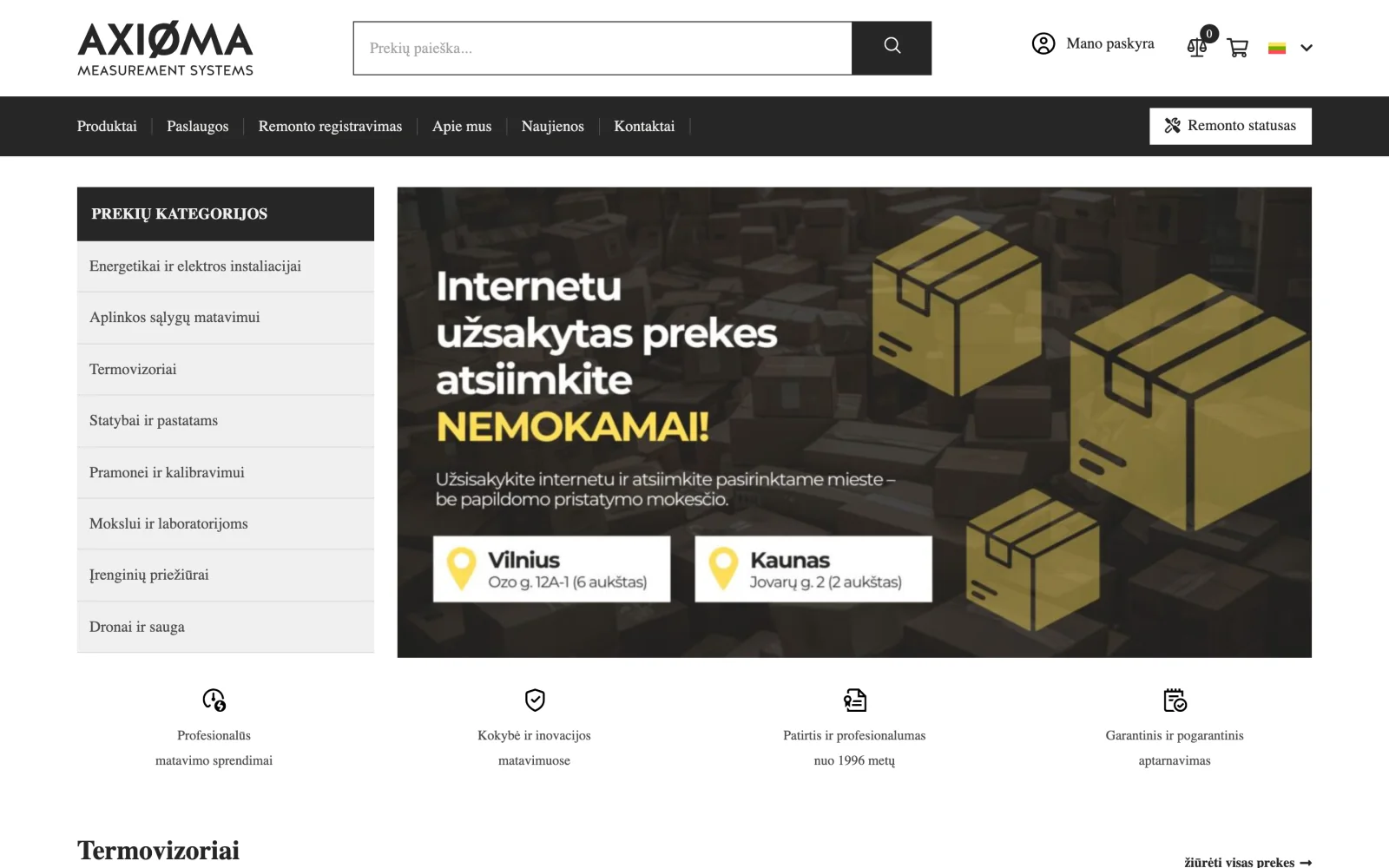
An online store for professional measuring equipment with a catalogue organised by application: construction, industry, laboratories and drones.
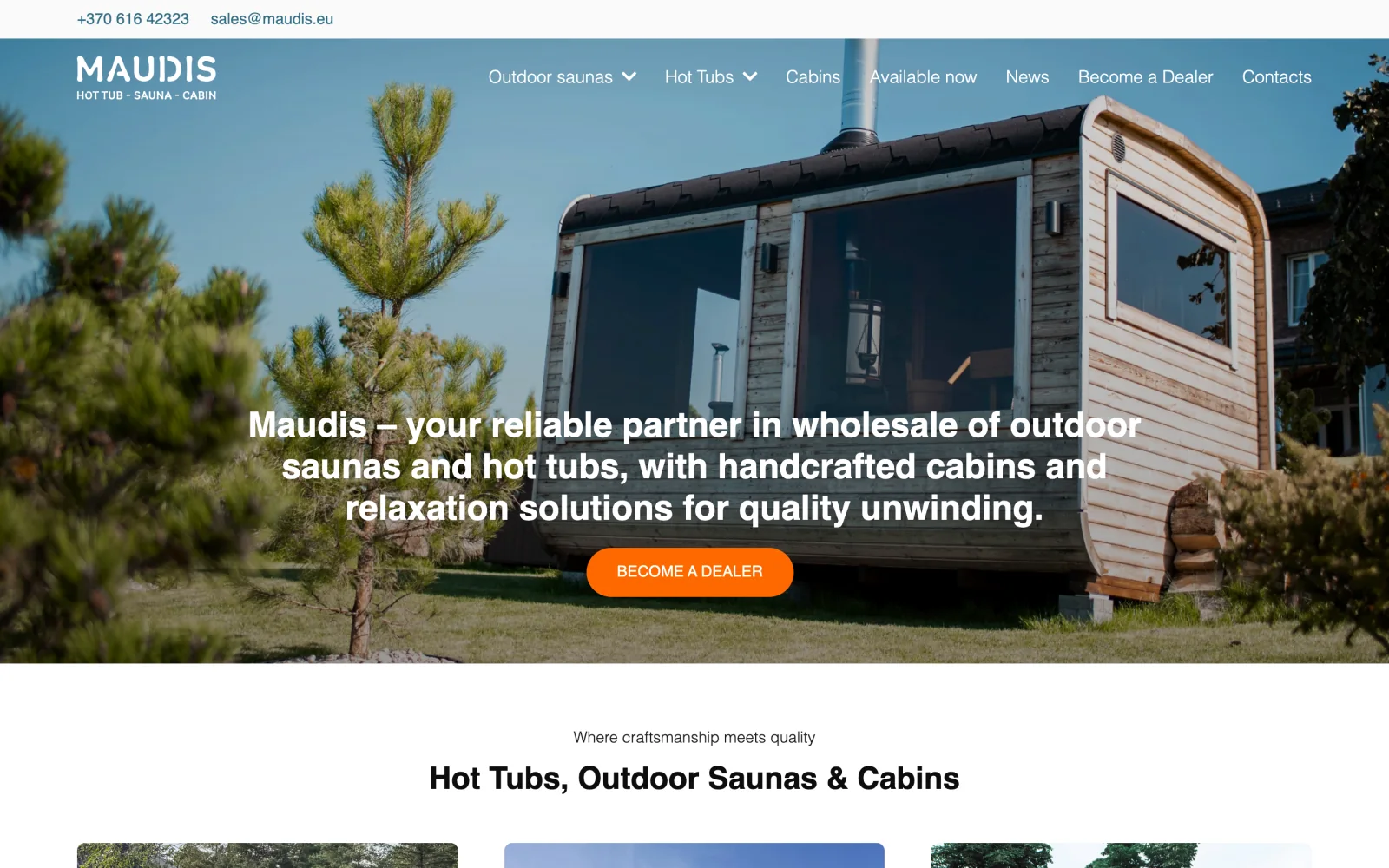
An English-language outdoor sauna and hot tub store with a wholesale focus: partner and dealer enquiries across Europe.
Tell us about the process that causes the most friction today. We will come back with questions within one business day.
Or directly: info@desamedia.lt · +370 686 59999